#56 - Writing that moves

Or why I keep writing year after year
#56 - Writing that moves
"What a Loving, and Beautiful World"

I write a lot about Product on this newsletter, but that hasn't always been the case. If you include all the emo rants about despair, dreams, heartbreaks & book reviews on my obscure personal blog, then I published the very first such piece about ten years ago. I'd like to think that I'd be a struggling writer if I had never been in tech!

Anyway, having written online for a decade, I feel entitled to say a few words about why I keep writing year after year.

First of all, writing is hard work, especially if you want to write something above average. These days, it's very easy to generate text using LLM, which begs the question: why do I even bother putting words one after another myself?

Let’s enumerate a few possible reasons - and why none of them quite make sense.

  • Publicity. Most of my blog posts don’t reach more than a thousand people. This newsletter has about six hundred subscribers, give or take, and that number increases by about three percent every month. That seems like a bad return on investment if you’re looking for notoriety. If I wanted fame, I would have just focused on the latest trends, controversial topics, or drama within the industry. There’s no shortage of topics that enrage people, and some have adopted this as their personal branding approach. For better or worse, it’s never been my cup of tea.
  • Monetary. I don't make any meaningful money from this newsletter, except from that one person who paid for an annual subscription (thanks!). Like I said, I would be a struggling writer if I hadn't been in tech.
  • Distribution. I do promote my course and new products here occasionally, so it is a distribution channel, but it typically takes months between writing a good piece and someone signing up for anything. I never really know what piece has what effect, so distribution is really more of a hypothesis and less of a benefit. That said, if you do end up signing up for the course or for any product because of my blog posts, I'd be elated.
  • Cognition. There was a time when I genuinely believed that writing is thinking. The truth is, I don’t have to write this much just to think better. Writing helps sharpen thinking, but it’s simply naive to say that writing is thinking. There are abstract modes of thought beyond language that one can use to strengthen cognitive abilities. Don’t get me wrong - writing is definitely a powerful way to manipulate and refine mental representations. That’s what good thinking is all about. It’s just not why I keep writing year after year.

The most satisfying answer to the (troubling) question of why exactly I write is that I love being moved by words, and I love the thought that I can also move someone else with words. In this sense, I love writing for the same reason that I love Product Management.

This may sound aspirational, as if it requires producing masterpieces or classics. But writing that moves people doesn’t have to be complex or literary. Sometimes it’s enough to articulate a deep idea you already understand intuitively, in a way that allows others to finally put their finger on it.

One of the recent essays that moved me was "Make something by heavy" by Anu. I've always known that I want to build something of substance, but the framing "make something heavy" just hits different. It hits heavy. But there's also a sense of communion when I read that piece, knowing that there are individuals out there who pay attention to the same aspects of reality. I shared the essay with a dear friend of mine who was also deeply touched, and it was a bonding moment for us. Humans are more alike in what deeply resonates than we are different.

Another example: a while ago, many junior PMs reached out and asked me the same question: "What skills should I learn?" I've always found that question to be unhelpfully constrained. In a moment of deep thought, I arrived at a reframing around how you should focus on organizational needs as the starting point for up-skilling. I quickly wrap an essay around that insight and published it in one sitting, which usually means that it's not thoroughly refined. Fast forward a few days, I received a few DMs/comments telling me how the piece resonated. Whether their behaviors actually changed or not is hard to determine, but I'm glad the piece tipped the scale in some capacities.

Writing that moves people is what keeps me doing this year after year.


But what does being moved actually feel like? It’s hard to describe, but a recent experience brought me closer to an answer. My wife and I visited Japan a couple of weeks ago - seven days in Osaka, seven in Kyoto, and New Year’s Eve at a friend’s place in between. In Kyoto, we visited the teamLab exhibition, a high-dimensional experiential space built around perceiving the world through the body.

Here's how they describe themselves:

TeamLab (f. 2001) is an international art collective. Their collaborative practice seeks to navigate the confluence of art, science, technology, and the natural world. Through art, the interdisciplinary group of specialists, including artists, programmers, engineers, CG animators, mathematicians, and architects, aims to explore the relationship between the self and the world, and new forms of perception.

In order to understand the world around them, people separate it into independent entities with perceived boundaries between them. teamLab seeks to transcend these boundaries in our perceptions of the world, of the relationship between the self and the world, and of the continuity of time. Everything exists in a long, fragile yet miraculous, borderless continuity.

Over ten thousand square meters, it display new and unreleased artworks that cannot be seen anywhere else in Japan. The museum spans four levels - Underground, Sculpture and Painting, Megaliths, and the Athletics Forest - with a suggested route to guide your visit. That said, you’re free to wander, loop back, and revisit any artworks as often as you like, whether to savor the experience or to take more photos. But if possible, you should stand still for a long time. The boundary between my body and space dissipated as I stood and stared at a particular installation.

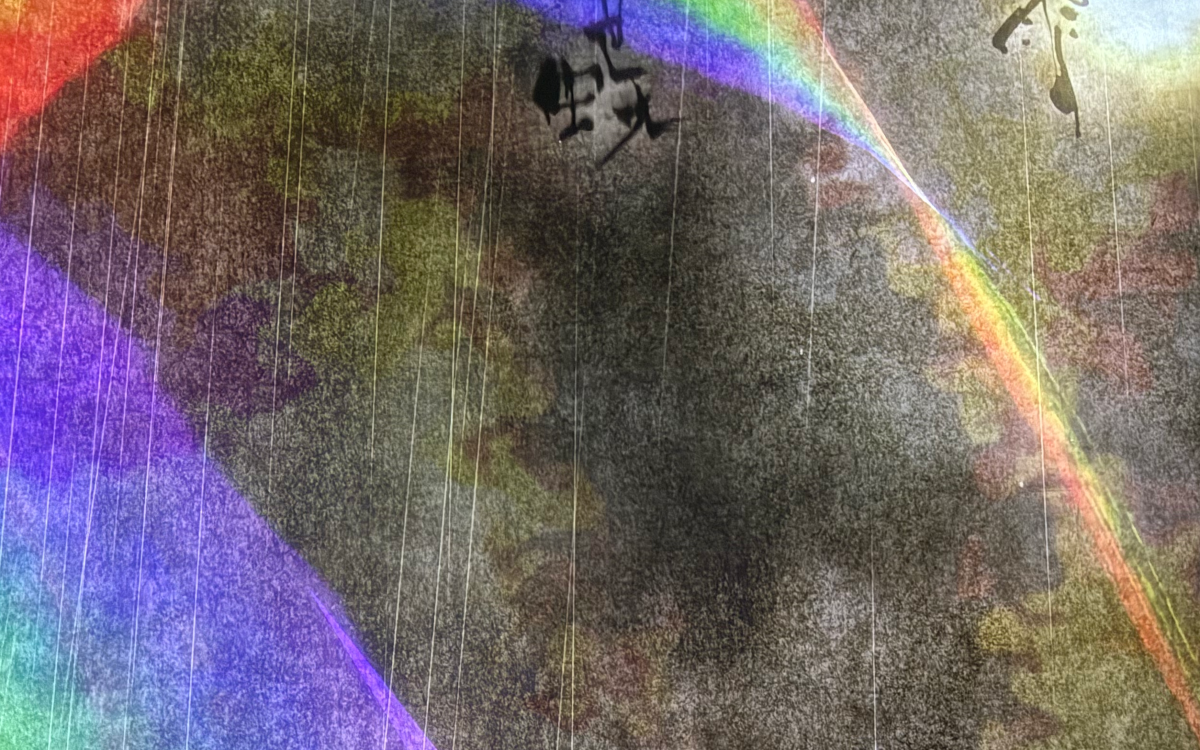
The artwork that held me captive was an installation titled "What a Loving, and Beautiful World". Its description reads as follows: "Each character has its own world. When people touch the letters, the worlds of the characters appear, and they influence each other, creating one single world. Rain, snow, and flowers are affected by the wind, birds perch on trees, and butterflies are attracted to flowers. When other artworks touch the letters, the worlds they contain appear as well. The worlds created by people interact with the worlds created by other people and other works, creating new imagery. The artwork seen at this moment in time can never be seen again."

Me at the installation titled "What a Loving, and Beautiful World"

For me, this is what writing that moves feels like: a visceral experience of being captivated. It makes me alert and pay attention. It reawakens my perception, returning me to a more primitive world of gods and demons, good and evil, love and hate, rainbows and storms. Against the backdrop of everyday life, perceptions burst into light with vivid contrast.

Authors who produce great writing are capable of reaching several layers deep into the nature of their own unique human experience, extracting fundamental truths, and wrapping them in a solid conceptual handle. If you permit these ideas to enter your mind from time to time, they come into contact with your existing conception of the world, sometimes subtly and sometimes loudly. The debris from such collisions reconfigures worldviews, alters behaviors, and ultimately transforms you as an individual.

When your perception becomes attuned to the possibility of such transformations, you start to develop a desire to help others do the same. That’s why it always seems odd to me when I see AI-generated blog posts. How can LLMs reach deeply into their own unique human experience and transform people when they aren’t human and have no lived experience at all? I’ve been using LLMs ever since ChatGPT 3.0 was released, but they have never written a single thing that moved me.

If you want to break your perception out of the everyday life, rediscovering what it means to experience, seeking the possibility of being moved and moving others with greatness, you should craft something with care. A piece of writing, a product, a course, anything that embeds your unique human experience. In fact, that's my entire conclusion: writing, or anything for that matter, that moves people is crafted by someone who really cared. This is why I continue to write - because I care.